19 April 2024
Doing IPS Symposium 2024: Navigating catastrophic times
09.30-19.00, The Octagon, Queen’s Building, Queen Mary University of London
The symposium is co-organised with QMUL, IHSS Environmental Future Programme and the TheoryLAB.
Organisers: Giulia Carabelli, Jef Huysmans, Mirko Palestrino, Elke Schwarz
Register here.
This symposium interrogates discourses and imaginaries of intensified crises threatening the survival of individuals, nations, species, and the planet. The menace of multiplying catastrophic events, such as global wars and extinction, can lead to pervasive defeatism and depression or end-time forms of hedonism and thinking. We explore if and how navigating catastrophic times can also reenergise political discourses and practices as a means to re-assign meanings to a life in peril and to re-locate deflated hopes. We are interested in how apocalyptic horizons move individuals to take action in the present, which is all we have against a felt-approaching end-time. In other words, we are interested in how end-thinking and urgency play a role in politicising environmental challenges, migration, global health, and other issues. In so doing we wish to interrogate the politics of catastrophic thinking to activate imaginaries that stretch, re-write, re-think the future anew. To unpack these dynamics, the symposium brings together scholars from across the humanities and social sciences around three thematic roundtables on the Planthroposcene, military imaginaries and theories of time.
Roundtable 1: The Planthroposcene
This roundtable is preoccupied with environmental catastrophes and extinction. Our starting point is Natasha Myers’ concept of the Planthroposcene: a vision of the future “grounded in the relationship between plants and people”. For Myers, the Planthropocene is an attitude towards life that is appreciative of nonhuman agency to redefine the meanings and politics of social justice. In this roundtable, we explore modes of communing with plants at home, in gardens, and green spaces outside the city. We present examples that could illustrate the practicing of the Planthroposcene at a time of environmental doom to explore how plant-care-work enables different imaginaries of the future and its temporalities. We ask, what does it mean to commune with plants? What can plant-human solidarities produce? How can the Planthroposcene help us in the process of re-imagining the future?
Roundtable 2: Militarising end-times and the untimeliness of life
The roundtable explores military mobilisations of catastrophic and apocalyptic imaginaries and their implications. These imaginaries often emerge when highlighting the unique features of new military technologies and their impact on the existing global, international, or planetary order. Both the justifications for military developments and their contestations evoke catastrophic and apocalyptic visions, but their imaginaries differ. In ongoing debates surrounding the use of Artificial Intelligence and the creation of autonomous weaponry, concerns are raised about the end of human autonomy. Discussions on nuclear weapons often have involved the potential for the end of civilisations and apocalyptic destruction of life on Earth, leading to contesting views on nuclear armament. The concept of an impending planetary disaster resulting from climate change draws on the parallel advancements in meteorology and nuclear weaponry, which sparked the creation of doomsday scenarios depicting a nuclear winter. In navigating the contemporary, it is equally crucial to examine points of view that address the risks and issues of the present day without resorting to apocalyptic and catastrophic imaginings that portray the current era as yet another end-time, a time when ways of life are facing existential threats, and everything that is known or familiar is on the verge of extinction. This roundtable explores: in which ways are apocalyptic ideas present in the development and evaluation of military technology? What are the potential drawbacks and risks of using catastrophic scenarios to study military practice and technology? What are possible alternative ways of critically examining militarization and military advancements that do not rely on end-time depictions?
Roundtable 3: Timing without an end? The role of finitude and finality for theorizing time.
Catastrophic and apocalyptic events, imaginaries and rhetoric do not just play a key role in politicising issues, but also in timing them. Wartime-like exceptional measures, for instance, are contingent on their temporariness and the promise of peace- or normal times to come. Modalities of urgent, abrupt, and finite end-thinking also seem to lie at the very core of how we think about time and temporality in the first place. In traditional distinctions between natural and historical time, the former sets the limits of the latter. Historical time, in turn, is premised on the intrinsically finite phenomenological categories of experience and expectation. Similarly, social constructionist understandings of times, are often equally anthropocentric and therefore temporally bounded. This roundtable seeks to critically engage and re-think some of the very theoretical premises of catastrophism and apocalypticism: end-thinking and temporal limits. It asks: is it desirable and even possible to think time without endings, limits, and other temporal boundaries? Which socio-political possibilities and horizons do we open up if we de-link time and temporality from finality and finitude?
Programme
09:30 – 10:00 Welcome Coffee
10:00 – 10:30 Introduction
10:30 – 12:00 Roundtable 1: The Planthroposcene
Chair: Giulia Carabelli
Speakers: Larisa Jasarevic (independent), Imayna Caceres (Akademie der bildenden Künste Wien), Martin Savransky (Goldsmiths, University of London), Darya Tsymbalyuk (New Europe College)
12:00 – 13:00 Lunch
13:00 – 14:30 Roundtable 2: Militarising end-times and the untimeliness of life
Chair: Jef Huysmans
Speakers: Antoine Bousquet (Swedish Defence University), Caroline Holmqvist (Swedisch Defence University), Rens van Munster (Danish Institute for International Studies), Elke Schwarz (Queen Mary University of London)
14:30 – 15:00 Tea & Coffee Break
15:00 – 16:30 Roundtable 3: Timing without an end? The role of finitude and finality for theorising time.
Chair: Mirko Palestrino
Speakers: Melissa Gatter (University of Sussex), Andrew Hom (University of Edinburgh), Nomi Claire Lazar (University of Ottawa), Delfi Nieto-Isabel (Queen Mary University of London)
16:30 – 19:00 Conclusion and Reception
28 February 2024
Book Launch
Global Politics: Myths and Mysteries
17.15-18.45, Room 2.17, ArtsTwo Building / online, 335 Mile End Road London E1 4FQ
This event is hosted by Global Politics Unbound and TheoryLAB at the School of Politics and International Relations, Queen Mary University of London.
Join the authors – Drs Aggie Hirst, Diego de Merich, Joe Hoover, and Roberto Roccu – online or in person for the launch of Global Politics: Myths and Mysteries (OUP 2023), “the only text that centres students’ critical thinking skills, empowering them to become truly independent thinkers of global politics”.
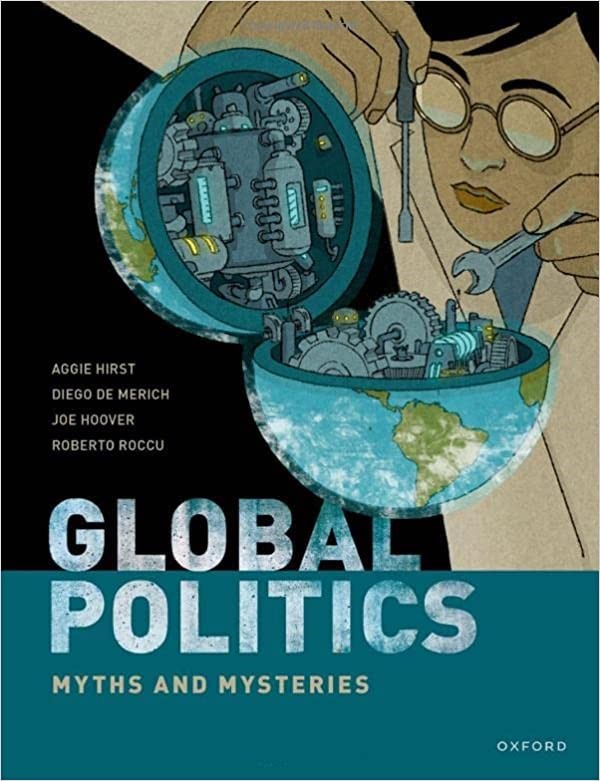
Global Politics: Myths and Mysteries is an innovative introduction to key concepts in international relations, exposing the myths of the discipline, and making critical thinking engaging and relatable for students. It takes a critical pedagogical approach to help students to develop theoretical reflexivity and independent critical thinking skills.
Myths and Mysteries teaches students both how their common sense understanding of international politics is already theoretical and how they can become more critical and sophisticated thinkers by learning to think theoretically. Rather than introducing students to disciplinary histories or theoretical ‘-isms’, Myths and Mysteries mobilises students’ inherent interest and latent understanding of international politics, exposing the myths we rely on to answer perennial mysteries about international politics. In doing so, it shows them that theory is a verb and is for everyone.
The authors will be joined by Professor Mervyn Frost (KCL) and Professor Kimberly Hutchings (QMUL) to discuss the key themes of the book, and its many uses in the university classroom.
Buy the book here.
1 November 2023
Jewish Self-Determination Beyond Zionism
17.30-19.00, People’s Palace 1, Queen Mary University of London Mile End Campus London E1 4NS
Jonathan Graubart is a professor of political science at San Diego State. He specializes in the areas of international relations, international law, Zionism and Jewish dissent, Israel-Palestine, the UN, normative theory, and resistance politics. Graubart is the author of Legalizing Transnational Activism: The Struggle to Gain Social Change from NAFTA’s Citizen Petitions (Penn State University Press, 2008).
Jewish Self-Determination beyond Zionism examines the liberal Zionist and Jewish anti-Zionist perspectives that developed in the decades following Israeli statehood. In his timely book, Jonathan Graubart, advances a non-statist vision of Jewish self-determination to be realized in a binational political arrangement that rejects Apartheid practices and features a just and collaborative coexistence of Israeli Jews and Palestinian Arabs. The book’s vision advances a distinct Jewish self-determination committed to cultural enrichment and emancipation, internationalism, and the fostering of new political, social, and economic channels for attaining genuine reconciliation between Israelis and Palestinians.
Jewish Self-Determination beyond Zionism also engages a Humanist Zionist vision to confront the Zionist movement’s foundational sins and demands a full reckoning with the Palestinians.
Graubart focuses on two of Humanist Zionism’s most insightful thinkers, Martin Buber and Hannah Arendt, putting them “in conversation” with each other, and synthesizing their collective insights and critical Jewish perspectives alongside the ideas of Noam Chomsky, Judith Butler, Ella Shohat, Edward Said, and other philosophers and academics. Jewish Self-Determination beyond Zionism concludes that an updated, binational program is the best path forward.
Buy the book here.
21 September 2023
Workshop on Urban Political Theory
10.00-18.00, The Sofa Room, Department W, Queen Mary University of London, 81 Mile End Road, London E1 4UJ
Jointly funded by the PSA Political Thought specialist group and TheoryLAB at Queen Mary, the workshop invites scholars to present, and engage with, new research that is focused on exploring normative questions at the scale of cities and urban communities. Through this workshop we aim to provide informal peer-review and feedback on emerging publications, whilst also supporting the development of a new network of researchers working within this area of study.
Programme
10.00-10.30 – Welcome
10.30-11.30 – “Why go local? Three opportunities and three risks,” by James Hickson (Liverpool) and Marta Wojciechowksa (KCL) [Respondent: Joe Hoover (QMUL)]
11.30-12.30 – “Residential Choice, Exclusionary Zoning, and Neighbourhood Quotas,” by Andrew Walton (Newcastle) [Respondent: Andrei Poama (Leiden)]
12.30-13.30 – Lunch
13.30-14.30 – “Urban Democratic Innovations: Practising the Right to the City,” by Verena Frick (Göttingen)[Respondent: Estelle Broyer (QMUL)]
14.30-15.30 – “City of Equals,” by Jo Wolff (Oxford) [Respondent: Marta Wojciechowska (KCL)]
15.30-16.00 – Break (with catering)
16.00-17.00 – “Public Political Philosophy: from concept to city,” by Jonathan Floyd [Respondent: James Hickson (Liverpool)]
17.00-17.30 – Wrap up
24 May 2023
Hunker in Your Bunker: Doomsday Prepping in the United States
17.30-19.00, The Hitchcock Theatre, Arts One Building, Room G.19, Queen Mary University of London Mile End Campus London E1 4NS
Prof Robert E. Kirsch
Assistant professor of Leadership and Integrative Studies at Arizona State University (USA). He is the co-author, with Emily Ray, of the forthcoming book Worst Case Scenario: The Politics of Prepping in America, from Columbia University Press. His broader research agenda focuses on Frankfurt School critical theory, in particular Herbert Marcuse, as well as environmental political theory.

During the middle of the twentieth century, the United States encouraged citizens to take it upon themselves to construct domestic fallout shelters in the case of nuclear war. Leaving aside the wisdom of this policy or its actual implementation, what makes the US a unique site of analysis is that it never was required to use any of these bunkers for their intended purpose, either from nuclear or conventional warfare. As bunkers remained a fantastical abstraction, dovetailed with the rise of neoliberal responsibility about protecting oneself, Americans could envision bunkering so perfectly that it reproduced everyday life, in perhaps smaller quarters. This persistent abstraction, and at the zenith of personality responsibility for risk management, leads to the phenomenon of ‘bunkerization’. Bunkerization is an organizing principle of everyday life where rather than building exterior fallout shelters or bunkers, Americans are invited to reimagine their domiciles as bunker spaces. This talk theorizes the political valence of such a bunkerized life.
25 January 2023
Lockean Property Ethics and Restitution
18.00-19.30, QMUL Graduate Centre, Room 601 Mile End Road London E1 4NS
Dr David Jarett
David received his PhD and works at Queen Mary University of London. His main area of interest is testing how far liberal and conservative arguments for maintaining existing private property titles actually work.
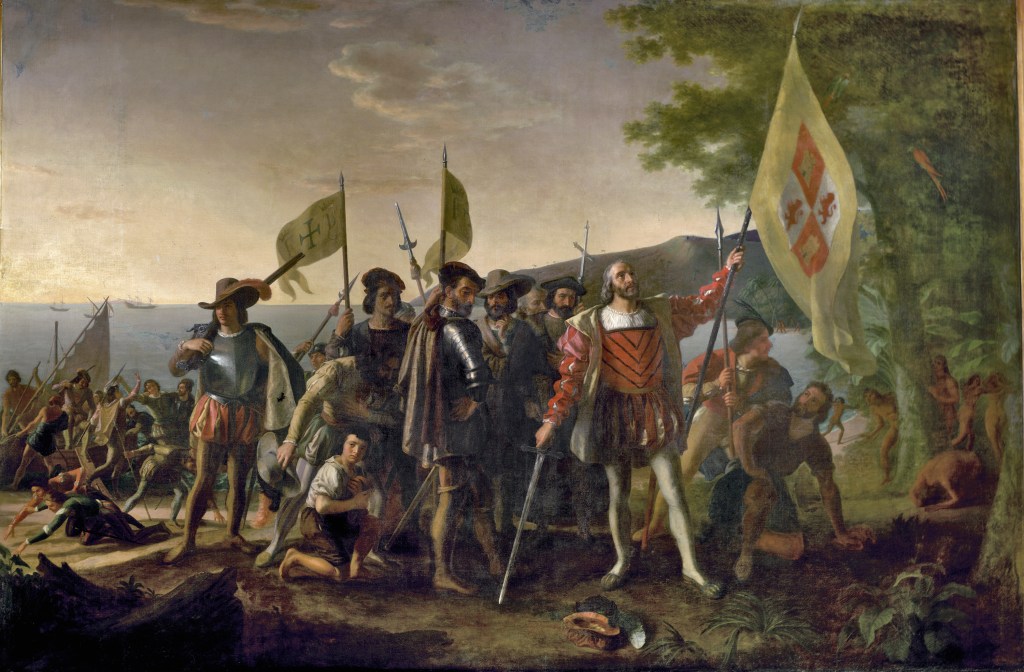
TheoryLAB welcomes Dr David Jarrett to discuss his recent book Lockean Property Ethics and Restitution, in which he argues that the influential Lockean thesis of justice in property, which traces back to John Locke, seems to require considerable egalitarian property redistribution. Where Lockeans argue that people justly own property gained through labour, transfer, or as compensation, Jarrett focuses on the problem of property which did not arise in line with Lockean justice. What do we do about property which derives from feudal and colonial conquest, for example? Drawing on a range of theoretical and historical sources, this book argues that the legal concept of restitution is the most reasonable way to address the problem. If we apply this concept, it appears that much property in the world is held unjustly and should be redistributed in an egalitarian manner.
Buy the book here.
20 October 2022
The Politics of Refuge: Sanctuary Policies in the US, UK, and Europe
Prof Benjamin Gonzalez O’Brien
Associate Professor of Political Science at San Diego State University. He is the author of two books on U.S. immigration policy: Handcuffs and Chain Link: Criminalizing the Undocumented in America (Univ. of Virginia Press, 2018) and Sanctuary Cities: The Politics of Refuge (Oxford UP, 2019).
Prof Elena Vacchelli
Associate Professor of Sociology at University of Greenwich, London. Her areas of expertise include migration, gender, urban studies and embodied, art-based and digital research approaches. Her monograph Embodied research in migration studies: using creative and participatory approaches (2018) was published by Policy Press, Bristol.
Sophie Gregory
Campaigns and Communications Manager for the Lewisham Refugee and Migrant Network (LRMN). The LRMN have been empowering refugees, migrants and asylum seekers to rebuild their lives since 1992.
Dr Raffaele Bazurli
Postdoctoral researcher at the School of Politics and International Relations of Queen Mary, University of London and at Ca’ Foscari University of Venice. His research focuses on urban governance and politics, immigrant sanctuary and asylum, and social movements.
First passed in the United States in the 1980s to limit local participation in immigration enforcement, sanctuary policies have since spread throughout the international system. Advocates for these policies argue they increase immigrant incorporation and carry benefits not only for local immigrant groups, but for the wider community. Opponents argue they foster crime or labor competition and run counter to the national interest. Bringing together experts on sanctuary cities in the US, UK, and Europe, this roundtable will examine how these policies differ based on national context, the existing evidence for the effects they have, and the common cause shared by sanctuary localities, as well as the racialized aspects of immigration enforcement.
This event was jointly organised and sponsored by TheoryLAB in the School of Politics and International Relations and the City Centre in the School of Geography.
 TheoryLAB